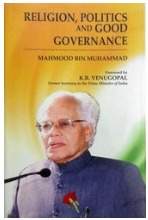
Religion, Politics and Good Governance - Indian edition 2009
FOREWORD
This book carrying the collection of essays by my longtime friend Mr. Mahmood bin Muhammad written at various times touching on such urgent issues as Indian and International politics, Islam and Good Governance including India's Criminal Justice System is a must read for all Indian citizens. I say all citizens because today all of us are concerned about all that is happening around us in the country and around us in the world with a sense of foreboding as these affect the very existence of our nation and also each one of us as citizens of this nation. This book is not just the outpourings of the heart of a great Indian patriot but one that carries a message to his compatriots on how to cope with the nation's most urgent problems from some one who has seen it all evolve over a period of time from the closest quarters as an administrator and as a diplomat, a rare and unusually valuable combination.
Every thinking Indian, or for that matter every thinking world citizen, knows today that his or her future depends on learning how to live in harmony with the environment and with fellow humans. Yet, we do not make the necessary effort because we do not summon the courage to grow out of some of our old habits and prejudices. While some of our own political loaders have acknowledged, in the international context, that we cannot choose our neighbours or change the physical neighbourhood and hence must learn to live with them, alas, they have not cared to emphasize this truth in the context of our own domestic lives within our own country. May be, that is how we practise divisive politics based on religion and caste in our country. How to eschew this and how to live a life of harmony, emphasizing all that unites us Indians instead of emphasizing what divides us, is the central theme of the lectures collected here of my friend Mahmood bin Muhammad over time. To this noble effort he summons the wisdom of thinkers and visionaries of all religions, great political leaders and social bridge builders. The central and oft quoted message is of the great mystic Rumi: "Tu barai wasl kardan aamadi, na barai fasl kardan aamadi" which means "You come to the world to unite and not to divide." As we look at our own country and the world around us we now realize that the temples of learning seem not to have emphasized this truth often enough. That has been the problem.
This, despite all that our great religions and the leaders of the greatest generation that fought for our independence like Gandhiji, Nehru and Abul Kalam Azad taught us. What Mahmood bin Muhammad does here is ask the reader to pause for a moment in these difficult times, be it in regard to religion or politics or governance, and to reflect on what they taught us and go back to our roots of tolerance and oneness. The point is tellingly made that "we divide ourselves and therefore others rule us". As we go back in search of our own unity of thought and national purpose, it is not necessary for us to jettison our Individual strengths or cultural qualities because this nation of ours, as Indira Gandhi once explained to an American audience, is not so much a melting pot as indeed a salad bowl of a variety of fruits where every flavour and fragrance remained distinct, beautiful and attractive. Our cultures, languages and religions are not contrarian and India was made by the several caravans that came from all sides. Even as the author quotes Raghupati Sahay Gorakhpuri:
"Har tamfsey karwan is mulk mey atey gaye
Sub ko ghar milta gaya Hindusthan banta gaya"
Whatever can be said of the infinite variety of this globe can be equally well said of our own country and its mosaic-like cosmopolitanism. That cosmopolitanism is now under threat. The author analyses these and gives us the hope of a bright and united future by far-reaching suggestions relating to religious harmony and good governance that includes a responsible criminal justice system. In international terms, he calls for a visionary approach to a united Asia. This may sound a distant dream but I do not see an alternative to living in peace with all and such a vision has been, therefore, articulated none too soon. And his call for inter-faith dialogue within our own country deserves immediate attention.
This book comes at a time when our unity is really under threat and therefore our very nationhood. This situation can be of comfort to no one other than our enemies. I believe the contents of this book and the thoughts and hopes expressed here are an excellent starting point to rebuild our lost national innocence and therefore our threatened heritage of oneness, and to rebuild our strength as a nation. I share Mahmood bin Muhammad's optimism because I know we have it in us to prove that the clash of civilizations is a false prophecy.
K. R. Venugopal IAS (Retd)
FORMER SECRETARY
TO THE PRIME MINISTER OF
INDIA
PREFACE
The assorted collection of essays presented in this volume cover areas as varied as religion, politics, governance and administration of criminal justice. They reflect the entire gamut of my experience in these fields at the local, national and international levels. Providence gave me an opportunity to observe the wide spectrum of human behaviour and, as a diplomat, also to see how international society is managed, balances of power are preserved and peace maintained.
I have included here thirty three essays divided into five parts. The first part deals with Islam, the second and third with the Indian and international political situation, the fourth part with good governance and the last one with India's Criminal Justice-System. In all the essays, it has been my endeavour not only to diagnose and identity the problems but also to propose possible solutions.
These essays were written at different times over a period of more than a decade and appeared in various journals, magazines and newspapers (to whom I am grateful), and must, therefore, be read in the context in which they were written.
Basically, India is a religious society. When Jawaharlal Nehru was asked by Albert Einstein as to the most difficult task faced by him as Prime Minister of India, he replied: "To build a secular State in a religious society." This is essentially because of the Indian tradition of pluralism and pantheism. Mahatma Gandhi had said: "Those who think that religion has nothing to do with politics understand neither religion nor politics." (Autobiography) It is not a question of mixing religion with politics. It is about spiritualization of Man, not the State. On another occasion, Gandhiji had rightly said: "If a man reaches the heart of his own religion, he has reached the heart of others too."
The firm foundation of my own career was laid at home by my parents. Thanks to my upbringing, I came to understand, very early in life, the concept of "unity of religion, to look at controversial issues with a dispassionate and open mind and always to emphasize similarities, not differences. I believe in proof more than theories, results more than rhetoric. The reader will see glimpses of this trait, here and there, as he leafs through these pages.
As for politics in India, I am reminded of the wise words of J.K. Galbraith, a former U.S. Ambassador to India: "There is no other country in the world where politics attracts the interest of people more than in India.... And I can think of no task that I would less like than governing India as an autocrat." The two pre-requisites of good governance are an efficient and incorruptible bureaucracy and an honest and dedicated political leadership. Politicians make policies and laws but the implementation of these policies and laws are in the hands of the executive. This can only be guaranteed by an efficient and effective Criminal Justice System. The Police, Courts and Correctional Services are the three major components of this system, which must work in coordination with one another for the successful and speedy administration of justice.
I fervently hope that the book will serve the intended purpose of creating a better awareness and understanding in our younger generation of the complex issues involved, especially as they affect India, and help them in overcoming the challenges of the contemporary era.
Mahmood bin Muhammad
"Palm Grove,"
117, Shantinagar,
Hyderabad - 500 028
India