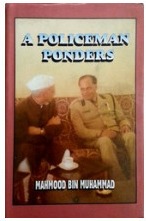
A Policeman Ponders - 1999
FOREWORD
Each life is a testimony of its original destiny which unfolds both directly and indirectly its movement towards a purposive end. Most people move unconsciously towards their ultimate ends by Providence whose wisdom and power are not always within our comprehension. But there are some people who are given first a vague intuition of their destiny in the beginning, which later obtains clarity of insight and vision as to their life's journey. The present autobiography is a story of one such life as has been conscious of its ultimate purposes linked with faith in the supreme beneficence of its Creator and Lord.
Each soul, according to my conviction, chooses such parents as are conducive to her destiny. I knew Mahmood' parents. Theirs was a soul-companionship. Even now after fifty years I can vividly recall their cheerful faces, the light of faith and simplicity that shone on them. Mahmood's father impressed me for his uprightness, singularity of purpose and integrity in relationships with whomsoever he dealt with. The mother was always smiling, and her eyes used to be filled with tears in moments of deep compassion and gratitude, a sign of a true believer in God. From his father Mahmood seemed to have received that sense of unflinching integrity which marked all his career, and from his mother he learnt how to remain humble in high office, how to remain a simple human being when called upon to face the most complicated situations. Hence, he gives such moving tributes to his parents as he starts telling his life story.
Mahmood's spirituality, though nurtured by his parents' faith and love, found its first source of inspiration in literature, particularly poetry. He started writing beautiful sonnets in English at an early age, and I hope someday his poetry also will be published. Hence, he punctuates his narrative with appropriate and charming couplets of Urdu and English poetry, a custom as old as ancient Arab biographies which included poetry as an integral part of story-telling. The poet in Mahmood's hidden self gives him poise which is the outer sign of the inner call for symmetry, for beauty, for the detached compassion for both the ordinary and the sublime, the sick and the wholesome in human nature and conduct. As a police officer, as a director of training and research, as a scholar and as a statesman Mahmood's poetic sense brings a redemptive touch to what is merely functional and mechanical. The poet in him is always his inner saviour, the messenger of grace and beauty.
Poetry is a signature of Divine Love which each soul ' carries as her most precious possession. Love is a divine gift which most of us waste upon such objects as are unworthy of love, transient and mortal. At its best, the love for the finite should be a sign moving us onward to the Real Beloved. Mahmood has a lover's style of his life's, narrative. All life is a story of love. His life too, from love of his parents, love of literature and graces of poetry, love of discipline and integrity to love of virtue which is another name for love of God. It is in this last love Mahmood's entire life is a pilgrimage in various disguises until he puts on the "ahram", the ultimate garment of the pilgrim par excellence to perform the Hajj, to come into the Presence of the Divinity of the Lord of the Ka'abah, the Lord of the Universe where one says : O Lord! here I am, bereft of all other garments and masks, roles and identities, as if newly born in the Divinity of Original Creation. Though outwardly a performance of the Islamic obligation Mahmood's narrative of the Pilgrimage brings tears to my eyes as it represents to me the culmination of his entire life as a pilgrim towards the Godness of God.
Mahmood's conscious pilgrimage through life coincides with the full half century of free India. After a very brief period of lecturership in English he enters the Indian Police Service in 1950.I leave to the reader to enjoy the intriguing details of his police career. What makes me reflect upon that career is something which is crucial to Mahmood's destiny as a Muslim in Modern India. When I look back over these fifty years I understand why I was asked to write the Foreword to his autobiography. Somehow his life and mine took the idea of pilgrimage seriously though in quite different modes and forms. I took the religious decision to remain in India, a multi-religious society, in order to come home in a world which was multi religious. I took religious diversity as a spiritual sign for mutual tolerance, patience and justice between communities and religions. Mahmood took a far more arduous decision to serve justice and order, uphold the rule of law, and practise objectivity of human worth and virtue in a society which went through communal fear and strife, caste divisions, and economic inequalities. Mahmood has demonstrated to us through his life story that one can remain a true Muslim while serving law and order in a multi-religious democratic State. I take this opportunity to make certain things absolutely clear on this sensitive and confusing issue.
Are you a Muslim first or an Indian first? Very rarely one asks: are you a Hindu first or an Indian first? Both questions are vulgar and are motivated by political suspicion at its worst and based on muddleheadedness to say the least. First and foremost, the term 'Hindu', is of recent origin (early 19th century by Europeans particularly in its abstract formation, namely Hinduism). The right question to ask is: are you a Vedantist first or an Indian first? This question is on par with the question about Islam and Indianness. The right answer to both the questions is that one is Muslim first. Vedantist first, and then an Indian. A Vedantist is one who practises Advaita (Absolute Non-Duality, Oneness, Unity of All Being). The term refers to his essential self, his Atma which is neither matter nor any body, which is neither of the East nor of the West. He is a Vedantist, a Unitary Self before all else, besides all else. Similarly a Muslim is one who surrenders to One Absolute Source of All Being, and it is to that Almighty Source he bows to the exclusion of anything else. Whether he is in India or Japan, England or Arabia, he is a Muslim first and everything else besides it. The absolute has priority over the Relative, the Eternal over the Temporal, the Self over the Ego, the Soul over one's historical and national identity. The question and the answer are now clear and are in their correct positions. There is no need or occasion for any embarrassment or hypocrisy to say otherwise. Only in a true state of Islam and realised state of Advaita both, one a Muslim and another a Hindu, could rightly and steadfastly serve the cause of justice and peace of, upholding human dignity and human rights in a democracy like that of India. Let us all take care not to confuse the issues and upset the priorities of the absolute and the relative values in any given situation, from inter-personal loyalties as fellow-humans to serving India with full honesty and zeal, being first spiritual beings and then historical and national identities. Let this matter be settled once for all.
Mahmood's life is studded with friendships with countless Hindu and Muslim contemporaries both in the official world and in his personal life. There are ministers, civil servants, police officers, from commissioners to constables. To each he is related in that fellowship of spirit which his inner Islamic heart imparts to him, that unfailing source wherein the Divine Compassion resides, available to one and all. Practising virtue, committed to the highest norms of morality and faith, he could rise as Muslim to represent the Indian Republic to a Muslim country which is the origin and source of Islam. His ambassadorship to Saudi Arabia was not only to build Saudi confidence in the Indian policies and planning for development but also an ideological bridge between a multi-religious society and that of a country which was fully Muslim. His appointment as an ambassador to a Muslim country was perhaps the best tribute the government of the day paid to Mahmood both as a true Muslim and a true Indian, a man faithful to God and therefore faithful to humanity, faithful to his country. The Universal loyalty can be truly practised by loyalty to the particular in conscious clarity of the true hierarchy of values.
Here is a life lived in simple faith that there is a guidance right within the soul of each one of us that guides by a gentleness kinder than that of a mother, wiser than that of the wisest of this world. At each step there is a light that goes before us. It is the light with which the best in us is always in agreement. Mahmood is convinced that to uphold the moral imperative is to honour that inner guidance. Hence, his life is a story of self-conscious virtue without losing its spontaneity and purity. The source of his virtue on the finite plane is his love and gratitude to his parents. This tremendous love he carries for his parents is a human token for his soul's love for her Fatherland, for her true Home in God.
Self-effacement is the bedrock of self-confidence in its most gracious form. Mahmood's journey through the life of this world is a continuous act of self-effacing humility before the mighty challenges of both self and society. His sense of self-critique is at the same time his courage to be critical of the institutions he served when they became oppressive of the moral and the spiritual essence of man. His analytical and empirical grasp of criminological issues as reflected in his papers both at the national and the international seminars and conferences gave him the stature of both a thinker and an administrator. Even as a diplomat he retains keen sense of the distinction between myth and reality, a sign of his highly developed sense of the gradations of reality from its cultural to its spiritual levels, from the romance of history to the politics of the day. To be a diplomat in a country where one is also a pilgrim is no ordinary challenge. Mahmood never loses his sense of the Qibla (Direction) that wheresoever one turns one faces God. His Attributes and His Signs. History is one of His Signs.
Mahmood concludes his memoirs with an enigmatic reference to his brief sojourn in Perth beyond which spreads the vast wilderness of the Western Australia. I wondered for quite a time why the memoirs end in Perth. What hidden significance is involved here? Why does the story end at the sight of the bewildering variety of the wild flowers of Perth and the vast signless desert beyond? Perhaps life, self-conscious life, is like an oasis in the vast wilderness of the cosmos. But is it really wilderness? Is not emptiness full with unseen and unseeable presence? Are not the wildflowers the heralds of undiscovered beauties in the Realm of the Divine creativity that is limitless, unbounded here and in hereafter. Each day God's Glory is new, the Qur'an says so beautifully. Life renewed and refreshed in that Glory is free from the bondage of time. There are no memoirs. All is living, ever-new.
Now, my dear reader, a life opens before you. It is a life of a particular individual. He is both the story and the story-teller. He is the Path and the Traveller at the same time. You are first going to step into the front courtyard of his life, his childhood and his youth. Step by step you will be led around the house, and then into the inner chambers of his mansion. At the heart of that inner space lies a sanctuary, the true essence of a man. That is sacred territory. That is holy ground. Only with purity of heart and with bowed head we may knock at the Door of that innermost sanctuary of another man's life. I leave it to you how you approach that golden threshold.
HASAN ASKARI
120, Valley Road
Pudsey,Leeds 22 April, 1995
- Prof. Dr. Hasan Askari of London.
Dr. Askari is listed as one of the eight Muslim thinkers of the
century in Kenneth Cragg's The Pen and the Faith (All & Unwin, 1984).
Preface
In the span of fifty years, I have played many roles and my life has passed through many vicissitudes. In the three phases of my public life in the pre-Independence, post-Independence and post-Andhra Pradesh periods, I have tasted both victory and defeat. I have navigated in the raging storm and in tranquil waters. I have swum with sharks without being eaten alive! I have experienced that sinking, trapped, panicky feeling you get when fighting life's toughest battle, I have also known how magnificent it is to be on a mountain-top and see "the full circle of God's glorious creation." In the words of the poet,
"Gardish-e-ayyam tera shukriya
Ham ne har pehlu se duniya dekhli. "
("Thanks to the whirligig of Time,
I have seen the world from all angles.")
My first inspiration to write these memoirs came as I laid down the reins office as Ambassador to the Kingdom of Saudi Arabia on 30 March, 1987. In fact, I had declared my intention to do so at a press interview that was published in the Arab News.
There is a British painting of a dead knight with the title "Mystery of Death". The painting illustrates the inscription :
"What I spent, I Had!
What I saved, I Lost!
What I gave, I Have!"
These three lines, to my mind, represent the summun bonum of human existence. Essentially, man is a trustee of God. The blessings we have received must be used to help others, not simply ourselves. A sixteenth century Sufi poet, Abdur Rahim, said: "A tree does not eat its fruit and the river does not drink its water." Prophet Muhammad (peace be upon him) stated : "Mankind is a fold every member of which shall be a shepherd unto every other, and be accountable for the welfare of the entire fold."
There is a revealed tradition of the Prophet in the form of a dialogue on the Day of Judgement, between God and man. God will address a particular individual:
"O son of Adam! I was sick but you never attended on me; I was hungry and you never offered me food; I was thirsty and you failed to give me water. Bewildered, the Man will reply: "O God! thou art the Supreme Lord of all the worlds. How is all this possible with thee? Then God will ask Man: "Do you not remember that so and so among my servants in your neighbourhood was ill, and so and so was suffering from hunger and thirst? Had you attended on them, you would surely have found me beside them." The ancient Hindu dictum is: "Serve, Love, Give." "Each one of you should look not only to your own interests, but also to the interests of others." This is the Profile of a Giver given by the apostle Paul in Philippians 2:4. Jesus Christ fed the hungry, comforted the grieving, healed the sick and clothed the naked.
To borrow an aphorism from Dale Carnegie, "Life truly is a boomerang, What you give, you get!" Let us, therefore, give. Let us not bother about "What's in it for me?" Let us lift our eyes from our own problems and focus them on those of others. If we show compassion to others, God will have compassion on us.
As Bill Clinton quoted from the Bible at the time of his installation as President: "Let us not be wary in well-doing for, in due season, we shall reap, IF WE FAINT NOT."
I have reaped, dear friend, and reaped far more than what I sowed.
At the risk of sounding immodest, let me say that I am amongst men who have stood for the right though the heavens tottered and the earth reeled. In ordinary matters, I always swam with the current but, in matters of principle, I have stood like a rock. Someone has put pithily: Cowardice asks, Is it safe? Expediency asks, Is it politic? Vanity asks, Is it popular? But Conscience asks, Is it right?
I have always looked upon defeat as the first step to something better. I would rather light a lamp and press forward than just sit, cursing the darkness. I would not like to be among who are left by the way-side, huffing and puffing and wringing their hands in despair. Right through my career, I have preferred to avoid the limelight and worked quietly behind the scenes. I believe in the saying that it's super to be famous, it's safer to be obscure.
I am an inveterate optimist at heart.
I would even jump the wall if a door cannot be unfastened. This attitude has helped me a great deal in finding solutions to problems, however knotty.
Most of all, I have always been myself, i.e., basically, an earthy human being. Ghalib expressed an eternal truth when he said:
"Bas ke dushwar hai har kaam ka aasan hona;
Aadmi ko bhi mayassar nahin insan hona.
(Difficult it is for any work to become easy,
Even for a person to be a human being is not easy.)
Was it Thomas Jefferson who said that it is more important to be human than it is to be important? "Most of the trouble in the world is caused by people wanting to be important," wrote T.S. Eliot.
My life is rife with incident and anecdote. Providence offered me opportunities to see different facets of human behaviour in all their rich diversity. I have had my share of the slings and arrows of misfortune, the hurts and failures, but my faith in the everflowing mercy of God has remained unshaken. The purpose of this effort is mainly to share the highlights of my experience with the younger generation so that they get inspired and better equipped to win life's battles.
Talking of experience. Field Marshal the Viscount Montgomery once pointed to his mule and said: "That mule has followed me on twenty campaigns!" "'Experience-is not what happens to a man." Aldous Huxley observed. "It is what a man does with what happens to him." The trajectory of my own career bears this out. I do not believe in advice, even good advice. "The only thing you can do with advice," quipped Oscar Wilde, "is to pass it on to others." This epigram is wholly applicable to the present day. Young people hear with their eyes, not ears!
As I say these words, I am tempted to recall the Aral proverb: "What comes from the lips reaches the ears. What comes from the heart reaches the heart."
For various reasons, this project had become a non starter. What all I needed was a spell of peace and quiet and a gentle push to do what I wanted. My compulsory vacation in Perth, Western Australia, from 1 October to 28 December 1992, was the most pleasing compulsion. It provided me with a right climate to complete my most pleasing task with a hope for the young world.
It is said that to understand a man, you must know his: memories. It is impossible for anyone to put all his thoughts words and actions of a lifetime in writing. As Mark Twain had said, "Biographies are but the clothes and buttons of the man — the biography of the man himself cannot be written."
I must record here my loving appreciation of Anees the talented and gallant lady who has stood by me through thick and thin and has always been my "safety net". She has tolerated my whims and fancies for over forty-five years with exceptional grace and devotion. It seems to me that we were married in Heaven, united on Earth!
When I behold you, sweet lady,
A soothing calm creeps over me.
The ringing bells and singing birds
Do help me discover in words
The soft music that dwells in you.
Yes, such women are few, so few!
The white lily and the red rose
Cannot but now to me disclose
That you are sweet as sweet can be.
And this is all I wish to see.
When I return home quite weary,
Like a faithful wave to the sea,
You greet me with a look so coy;
I leap, I dance, I sing for joy!
"I love you more than words can show;
Your presence helps my love to grow!
When you come, it is light, all light!
When you go, it is night, all night!
I love you well but know not why,
Yet I shall love you till I die.
(My poem, To.............. 1963)
MAHMOOD BIN MUHAMMAD
"Palm Grove"
117, Shantinagar
Hyderabad 500 028
Andhra Pradesh
India